Raw, Unprocessed Honey vs Processed Honey
Raw jungle honey vs processed honey: source, heat, filtration, crystallisation, adulteration risk, HMF, diastase, and why clear syrup is not always better.
Raw honey is not automatically pure, and processed honey is not automatically fake. The useful difference is whether the jar preserves source, season, aroma, and natural behaviour without unnecessary heating, over-filtration, or syrup adulteration.
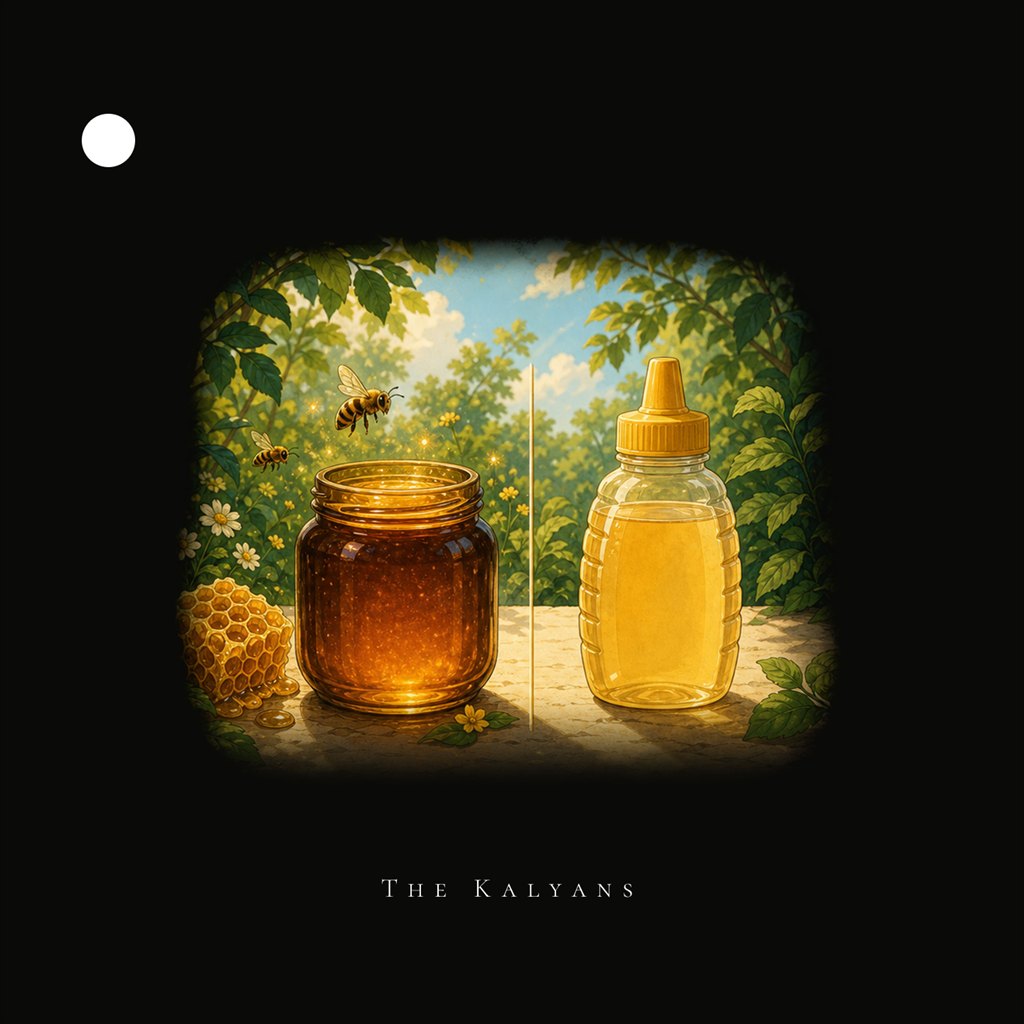
The difference between raw, unprocessed honey and processed honey is not just a label. It is the difference between protecting natural character and engineering honey for sameness.
Processed honey is often heated and filtered for clarity, flow, shelf appearance, and uniformity. These steps can make honey easier to sell at scale, but they can also flatten aroma, texture, and the sense of origin.
Raw honey keeps more of the batch visible
Raw unprocessed honey is handled with restraint. It may look darker, cloudier, thicker, thinner, or grainier than the honey people are trained to expect from supermarket shelves. Those traits alone do not prove purity, but they are normal for honey that has not been over-managed.
This is especially true for jungle honey. Bees forage across mixed vegetation, so the honey does not need to taste identical every time. A batch can carry floral, woody, earthy, sharp, mellow, or resinous notes depending on the season.
Processed honey is built for consistency
Large systems prefer predictable taste, predictable colour, and predictable flow. That consistency is convenient. It can also make honey feel less agricultural and more like a standard sweetener.
If you want an invisible sweetener, processed honey may satisfy the brief. If you want food with origin and character, raw unprocessed jungle honey is the more serious choice.
How to use raw honey at home
Do not add raw honey to boiling water or very hot food. Let the drink or dish cool until warm, then add honey. Use a dry spoon and close the jar after use. If it crystallises, warm the closed jar gently in warm water instead of microwaving it.
For texture changes after purchase, read Why Honey Crystallises. For storage, read How to Store Raw Jungle Honey.
Questions Most Labels Avoid
What does real honey fraud look like beyond a bad taste?
Fraud often looks normal. The European Commission's Joint Research Centre reported that a large share of sampled imported honey was suspected of being adulterated with sugar syrups. Read the official JRC honey fraud note. This is why visual clarity alone is a weak purity test.
A serious honey standard looks at source, batch records, moisture, heating, filtration, and whether the honey has been stretched with cheaper syrups.
Can clear honey still be adulterated?
Yes. Clarity is not proof. Some genuine honeys are clear, some are cloudy, and some crystallise. Adulteration can happen with sugar syrups that look perfectly normal, so the stronger questions are source, batch records, heating, moisture, and whether the seller can explain the honey beyond colour.
Which lab-style markers matter more than the word raw?
The Codex Standard for Honey uses measurable quality markers such as moisture, hydroxymethylfurfural (HMF), and diastase activity. HMF tends to rise with heat and storage stress, while diastase can fall with excessive heating. These tests do not replace sourcing, but they keep the conversation honest.